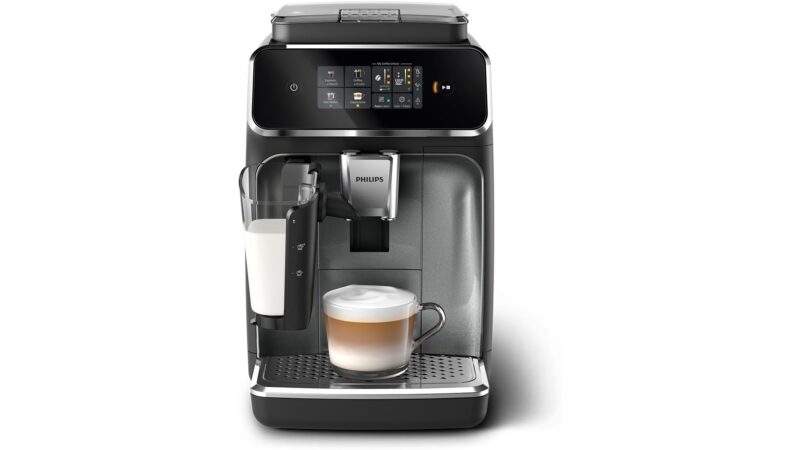
Plenty of people come to bean-to-cup machines the same way: a few winters of pod coffee, a growing pile of empty capsules, and a nagging feeling that the cappuccino from the café down the road is in a different league. The Philips Series 2300 LatteGo (model EP2339/40) is aimed squarely at that person. It doesn’t try to do twenty drinks. It does four, and the one most owners actually care about is the cappuccino.
I’ve gone through the full spec sheet and what UK owners are reporting so far, including the gripes, to work out whether it earns its spot on the worktop.
Quick verdict
- Good for: one to three people who mostly drink cappuccino, espresso or a black coffee and want fresh beans without learning to steam milk
- Best thing about it: the LatteGo milk jug, which is two plastic parts and no tubes, so cleaning it is a quick rinse
- Worth knowing: it’s not silent, whatever the SilentBrew badge suggests, and it takes a few days of fiddling to get your drink just right
- Skip it if: you want flat whites, latte macchiatos and iced drinks on a button, since you’ll need a pricier model for that
The four drinks, and why that’s fine
The touchscreen gives you espresso, coffee (a longer black coffee), cappuccino and hot water. That’s the whole menu. On paper it looks thin next to machines with a dozen icons, but one UK owner made a fair point: they’d rather it did the basics really well than spread itself across drinks nobody makes twice. You can still make a latte by hand if you like. Pour a bit more milk froth over a coffee, or just stir the cappuccino, which is what a couple of owners on the Philips site say they do.
The My Coffee Choice controls let you set strength, cup length and how much milk froth goes in, and you can choose one or two cups at a time for the black drinks. The ceramic grinder has 12 settings from fine to coarse. If you’d rather use pre-ground coffee now and then, there’s a slot for that too.
Will it fit?
Philips’ spec sheet puts it at 24.6cm wide, 37.1cm deep and 43.3cm tall. (The Amazon listing mixes up the width and depth, but the photos make it obvious which is which.) The narrow width is the good news for a small kitchen, since it doesn’t eat much worktop width. A standard 60cm-deep worktop swallows the depth easily. Height is the one to measure. Check the gap under your wall cupboards, and remember you’ll need to lift the bean lid to top it up.
Capacity is sensible for a small household:
- Water tank: 1.8 litres, filled from the front
- Bean hopper: 275g, with a sealed lid
- Grounds drawer: holds 12 used pucks before it needs emptying
- LatteGo milk jug: 0.26 litres
- Pump: 15 bar, 1500W
One owner who switched from a Nespresso said the tank, drip tray and grounds drawer were all big enough that they weren’t constantly emptying something, which counts for a lot on a busy morning.
What owners rate
- The milk froth. This comes up in nearly every review. It’s smooth and creamy, and Philips says it works with plant-based milks too, which matters if your household is half oat milk.
- Cleaning the milk system. LatteGo is two parts that clip together. You rinse them under the tap and you’re done. Anyone who’s had to fish dried milk out of a frother tube will see why owners like this.
- Coffee quality for the effort. Several people moving up from pods say the jump in flavour was obvious straight away. One owner who’d used office bean-to-cup machines for years said the coffee matched those.
- Setup. More than one reviewer found Philips’ own setup video easier to follow than the printed manual and was making coffee within minutes.
What owners don’t
- Noise. Philips markets SilentBrew, and some owners do find it quieter than older machines. Others don’t. One buyer said the grinding and frothing were “very noisy”, and another found the pump louder than the grinder. If you’re up before everyone else in a small flat, don’t expect it to go unnoticed.
- Trial and error. The machine doesn’t make it obvious how much water each length setting gives you, so expect a few days of tweaking before your usual mug comes out right.
- Mostly plastic. It feels well made, according to owners, but it’s a plastic body with some metal trim, not a chunk of stainless steel.
- Upkeep is real. Like any bean-to-cup, it needs a regular routine: rinsing the brew group, cleaning the drip tray, descaling or changing the filter. One owner called it weekly and monthly work that’s “well worth it”, which is a fair way to see it.
- Not many reviews yet. This is a newer model. The Amazon UK listing has only a few dozen ratings, and a lot of them come from Amazon Vine testers who got the machine free. Philips’ own UK site has more owner reviews. It’s a positive picture so far, but long-term reliability is still an open question.
Who should buy it
If your coffee life is a cappuccino in the morning and maybe an espresso after lunch, this is a tidy fit. It suits couples or small families where people want slightly different strengths, since you can change the settings in a couple of taps. It also suits anyone who’s tried a manual espresso machine and given up on the milk.
If you want more drinks on the menu, Philips’ 3300 and 5400 LatteGo models add more. If you’d rather keep things simpler and skip automatic milk altogether, our look at the De’Longhi Magnifica S covers a well-known alternative with a manual steam wand.
Getting a decent cup from day one
Run a few drinks through it before you judge the taste, because the first couple of shots from any new grinder tend to be off. Start the strength and grind in the middle and change one thing at a time. Go finer if the espresso runs thin and fast, coarser if it’s bitter and slow.
A tip from an owner that’s worth repeating: use matt, medium-roast beans rather than very dark, shiny ones. Oily beans can gum up a bean-to-cup grinder over time. If you live in a hard water area, the machine works with Philips’ AquaClean filter, which Philips says lets you skip descaling for up to 5,000 cups if you change the filter when prompted. Using it from the start saves a lot of hassle later.
Keeping it clean
Rinse the LatteGo jug after each milky drink. Philips recommends that, though one owner said they pop the jug in the fridge with leftover milk and clean it a bit less often. Empty the grounds drawer and drip tray when the machine tells you. Every week or so, take out the brew group and rinse it under the tap. It’s not dishwasher-safe, so give it a plain water rinse and let it air dry before putting it back. Follow the on-screen descale or AquaClean prompts, and see our guide on how often to descale a coffee maker if you’re not using the filter.
FAQ
Can the Philips 2300 LatteGo make a latte?
Not as a one-touch button. It has espresso, coffee, cappuccino and hot water. You can make a latte-style drink by adding extra milk froth or stirring a cappuccino, which is what several owners do.
Does it work with oat milk?
Philips says LatteGo works with plant-based milks. Results vary by brand, though. Barista-style oat milks generally froth better than the standard cartons. Our oat milk frothing post covers why.
Is it quiet?
Quieter than some older bean-to-cup machines, according to Philips and a few owners, but not quiet. Grinding and the pump are both clearly audible.
Can I use pre-ground coffee?
Yes. The listing and retailer specs say it takes both whole beans and ground coffee, so a decaf for the evening is possible without emptying the hopper.
How big is it?
24.6cm wide, 37.1cm deep and 43.3cm tall, according to Philips. Check the height against your wall cupboards before ordering.
The verdict
I like that the Philips Series 2300 LatteGo knows what it’s for. Four drinks, good espresso, a properly frothy cappuccino, and a milk jug you can rinse in seconds. The noise and the early fiddling are real, and it’s too new to say much about how it holds up over years. Still, for a small UK household that mostly wants a decent cappuccino on a cold morning, it’s one of the more sensible bean-to-cup choices about.