When the mornings turn dark and cold, the appeal of a proper coffee at home goes up a notch, and the De’Longhi Magnifica S is the machine a lot of people in the UK end up buying for exactly that reason. It’s been around for years, it’s consistently one of Amazon UK’s best-selling bean-to-cup machines, and it has over 50,000 ratings. That’s a lot of real-world feedback to work with, so this review leans on what owners actually report, the good and the annoying, alongside the listing’s own specs.
The short version: it makes genuinely good espresso from fresh beans with very little effort, but the first day with it can be frustrating, and it asks for more upkeep than a pod machine.
At a glance
- Best for: someone moving up from pods or instant who wants fresh-ground coffee without learning to tamp and pull shots by hand
- Top feature: the built-in grinder with 13 settings, so beans go in the top and espresso comes out the bottom
- Watch out for: confusing instructions, frequent descaling prompts, and a minority of owners reporting faults within months
- Skip if: you mostly drink big, piping-hot mugs of black coffee, or you want a machine that froths milk for you at the press of a button
What it actually does
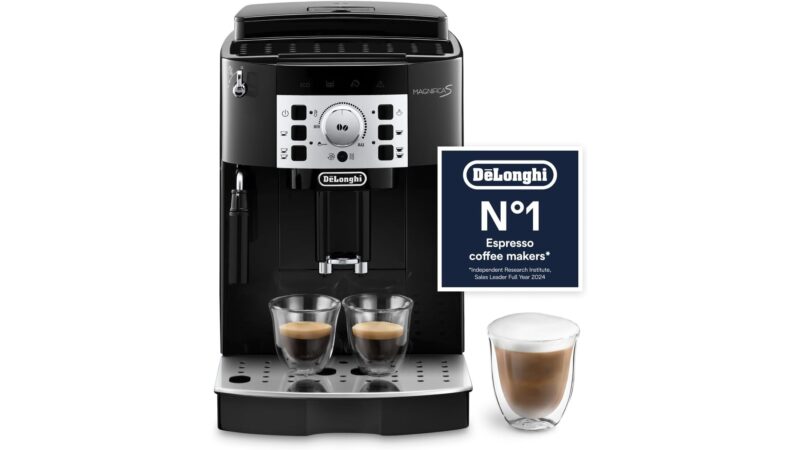
The Magnifica S is a fully automatic bean-to-cup machine. You fill the hopper on top with whole beans and the 1.8 litre water tank, press a button, and it grinds, doses, tamps and brews for you. The pump is rated at 15 bar, and there’s a dial for coffee strength and buttons for a single or double espresso or a longer coffee. It can also brew two cups at the same time.
There’s a separate chute for pre-ground coffee, which is handy if someone in the house drinks decaf and you don’t want to empty the hopper. Milk is handled by a manual steam wand on the side rather than an automatic milk system. You hold a jug under it and froth the milk yourself.
The machine rinses itself when you switch it on and again when you switch it off, which keeps the spouts clean but does mean water ends up in the drip tray.
Size and fitting it in a small kitchen
The listing gives the dimensions as roughly 24 x 43 x 35cm, and it weighs about 9kg. That’s compact for a bean-to-cup, but it’s still a lot bigger than a capsule machine like the Nespresso Essenza Mini. The bean hopper fills from the top, so if it lives under a wall cupboard you’ll probably need to slide it forward every time you top up the beans. At 9kg that’s doable, but not something you’ll enjoy doing daily. Measure the space before you order.
What owners like
- The coffee itself. This is the most consistent praise across the reviews. Fresh-ground espresso with proper crema, and noticeably better than pods according to people who’ve switched.
- Running costs. Several reviewers point out that buying beans works out more economical than capsules over time.
- Simple daily use. Once it’s set up, it’s a button press. One owner says it takes about three minutes from switching on to a finished coffee.
- Programmable cup sizes. You can teach each button how much water to use, and it repeats that every time.
- Longevity for some. One reviewer ran the previous model for around nine years without problems before replacing it with this one.
- The steam wand. A few people actually prefer it to automatic milk carafes because you control the milk temperature and there’s less to clean.
What owners don’t like
- The instructions. This comes up again and again. Several owners say the printed manual was close to useless and they set the machine up using YouTube videos and the QR-code tutorials instead. One very detailed review describes hours lost to a flashing warning light that turned out to be a red plastic plug hidden behind the drip tray, which had to be removed before the machine would work. Check behind the tray before you panic.
- Descaling nags. The machine prompts you to descale when it decides it’s due. Owners report anything from every few weeks to every three months. You can set your water hardness, which helps, and filtered water helps too.
- Black coffee that isn’t hot enough. One long-term reviewer found the long coffee button produced drinks that felt lukewarm for a big mug. Their fix was to steam some hot water into the cup first and then brew a double espresso into it.
- Reliability is mixed. It averages 4.3 stars, but about 9% of ratings are one star, and the review summary flags reliability and durability as the main complaints. Some machines run for years. Others develop faults within months. Keep the box and your receipt for the first few weeks.
- The grinder is loud. Opinions vary, but more than one owner describes it as about as noisy as a standalone electric grinder.
- The pre-ground chute can be messy. One owner gave up on it because fine grounds stuck inside the machine. Another found it dumped the coffee straight out if they added it before switching on.
Who it’s for
It suits someone who drinks espresso, flat whites or cappuccinos every day, wants fresh beans without the faff of a manual machine, and doesn’t mind a bit of routine maintenance. If you’d enjoy learning to pull shots yourself and want more control, a manual machine like the De’Longhi Dedica or the Sage Bambino Plus is smaller and gives you more to play with. If you want almost zero upkeep, stick with pods.
Getting a good cup out of it
Expect the first few coffees to be a bit off. Owners who were disappointed at first mostly say it improved once they adjusted the grind setting a click at a time and tried a few different beans. A couple of practical tips from people who’ve lived with it:
- Leave an empty mug under the spouts when you switch it on and off. It catches the rinse water, so you empty the drip tray far less often.
- Make small grind changes and give it a couple of coffees to settle before judging the result. The manual explains when the dial can be turned, and it’s worth checking that bit.
- For oat milk, a barista-style version froths much better on a steam wand than the standard cartons. Our oat milk frothing guide covers why.
- Keep your beans in an airtight container rather than a rolled-up bag. More on that in our guide to keeping coffee beans fresh.
Cleaning and upkeep
Day to day, you empty the grounds container and drip tray and wipe the steam wand straight after each use, before the milk dries on. The brew unit slides out so you can rinse it under the tap. Descaling is the bigger job. The machine has a programme for it, and you’ll need descaler to hand. If you live in a hard water area, it’s worth reading our piece on how often to descale a coffee maker before you set the hardness level.
FAQ
Does the De’Longhi Magnifica S froth milk automatically?
No. It has a manual steam wand, so you froth the milk yourself in a jug. De’Longhi sells other Magnifica versions with automatic milk systems if that matters to you.
Can I use ground coffee instead of beans?
Yes, there’s a separate chute for pre-ground coffee, which is useful for decaf. Owners say whole beans give better and cleaner results, though, so treat the chute as a backup.
Why won’t my new Magnifica S work even though the lights come on?
Check behind the drip tray for a red plastic plug. At least one owner found theirs stopped the machine working until it was removed, and the manual didn’t mention it.
How often does it need descaling?
It depends heavily on your water. Owners report anything from a few weeks to about three months. Setting the water hardness correctly and using filtered water both stretch the gap.
Is it noisy?
The grinding is loud for a few seconds, about the same as a standalone electric grinder. The rest of the brew is fairly quiet.
The verdict
If you want fresh beans without fuss, the Magnifica S delivers. It turns fresh beans into good espresso with one button, it’s compact by bean-to-cup standards, and it costs less to run than a pod habit. Go in knowing you’ll need a bit of patience on setup day, a supply of descaler, and some tolerance for the occasional nag, and it’s a solid first bean-to-cup for a small UK kitchen this winter.