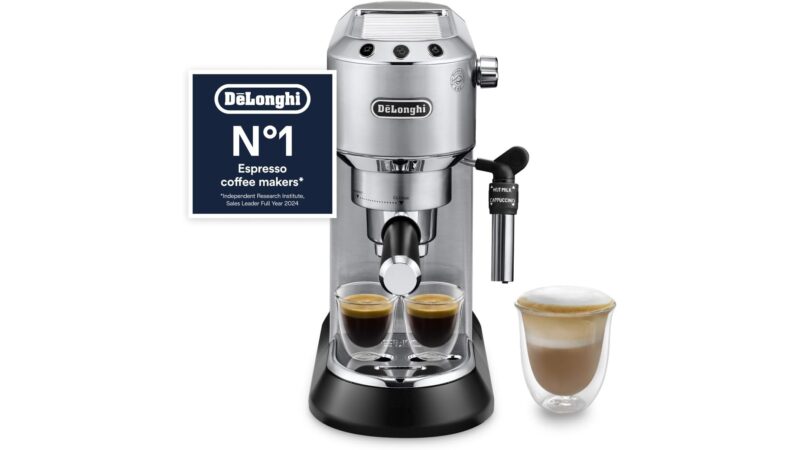
If you want proper espresso at home and your kitchen is the size of a corridor, the De’Longhi Dedica tends to come up first. It’s a traditional pump machine with a portafilter and a steam wand, the same basic kit a café uses, squeezed into a body only 15cm wide. The Dedica Style (model EC685.M) has been around for years and still sits near the top of Amazon UK’s espresso machine listings with over 33,000 ratings. So is it actually good, or just popular? Mostly good, with a few catches that are worth knowing about before it takes up residence next to your kettle.
Quick verdict
- Who it suits: someone who wants to learn real espresso and milk drinks without giving up half a worktop
- Size: 15cm wide, about 33cm deep and 30cm tall, weighing 4.2kg
- Makes: espresso from ground coffee or ESE pods, plus steamed or frothed milk for lattes and cappuccinos
- Biggest catch: reliability. It’s the main complaint in the reviews, and a minority of owners report machines failing inside a year
- Owner rating: 4.2 out of 5 from more than 33,000 ratings on Amazon UK when we checked
What you’re actually getting
This is a manual espresso machine, which means you do the work a bean-to-cup machine would do for you. You put ground coffee in the filter basket, tamp it down, lock the portafilter into the machine and press a button. There’s a 15 bar pump, three buttons on top (single shot, double shot and steam), and a 1 litre water tank that lifts off for filling.
It also takes ESE pods, the paper-wrapped single doses of ground coffee. That’s a bit of a hidden bonus. On a rushed weekday morning you can drop a pod in and skip the grinding and tamping, then go back to fresh grounds at the weekend when you’ve got time to fiddle.
The steam wand is what De’Longhi calls the Adjustable Cappuccino System. It has two settings, one for foamy cappuccino milk and one for hot milk that’s better for a flat white or a latte. It’s not a pro-style wand, but it’s far easier to get decent results from on your first few goes.
The space question
Width is where the Dedica wins. At 15cm it’s narrower than most toasters, and it’ll slot into gaps that a typical espresso machine never could. For a galley kitchen or a flat with one strip of worktop, that’s the whole reason to buy it.
Depth is the number people forget. It runs to about 33cm front to back, so on a shallow worktop it’ll come close to the edge. And the gap under the spout is short. Espresso cups and small glasses are fine, but a tall latte glass may not fit unless you take the drip tray out. If your usual morning drink is a big mug, think about whether you’d make the espresso in a small cup and pour it over.
What owners like
- The coffee itself. Taste and coffee quality are two of the most praised things in the reviews by a long way.
- It’s learnable. Plenty of buyers are first-timers moving up from a pod machine, and a common theme is that they got the hang of most drinks within a few attempts.
- It looks the part. The brushed metal finish gets a lot of compliments, which matters when it’s sitting on show in a small room.
- Compact size. Unsurprisingly, people with small kitchens mention this again and again.
- Value. Owners tend to see it as the sensible step up from a capsule machine, not an expensive hobby purchase.
What owners don’t like
The negatives aren’t the majority view, but they keep coming up, so here they are without the sugar coating.
- Reliability. This is the big one. Amazon’s own summary of the reviews flags reliability and durability as the things to consider, and there are reports of machines stopping working altogether, some within ten months. The 24-month warranty matters here, so keep your proof of purchase.
- Double shots can struggle. One owner who’d used theirs for six months found that a fully loaded, firmly tamped double basket would slow to a dribble or stall. A lighter tamp and a slightly coarser grind usually helps, but it shows this isn’t a machine that likes being pushed hard.
- The basket can stick. The same reviewer found the filter basket sometimes stayed up in the machine when they took the portafilter out, which makes knocking out the used coffee messy.
- Nothing goes in the dishwasher. The listing is clear on that. Everything’s a hand wash.
Is it right for you?
Yes, if you drink espresso, cappuccinos or flat whites most days, you’ve been spending a small fortune in coffee shops over winter, and you’re happy to spend a couple of minutes per cup getting it right. It’s especially good for anyone coming from a pod machine who wants to try proper espresso without committing serious money or space.
Probably not, if you want a coffee at the touch of one button with no thought involved. A capsule machine will suit you better, and our look at whether the Nespresso Vertuo Pop fits a tiny counter is a good place to start. If you mostly drink long black coffee, a filter machine or cafetière makes more sense too, and there are a few in our roundup of coffee makers for small UK kitchens.
Getting a decent shot out of it
- Switch it on and let it heat fully before your first shot. Run a little water through the empty portafilter to warm it up as well.
- Use coffee ground for espresso, and grind fresh if you can. Pre-ground goes stale quickly, and the Dedica will show it. Our pick of grinders worth the extra step might help.
- Fill the basket, level it, and tamp evenly. Not too hard. If the shot dribbles, ease off or go a touch coarser.
- For milk, use a small metal jug and keep the wand just under the surface until it’s foamed, then sink it a little deeper to heat through. Oat milk works too, with a bit of practice (more on frothing oat milk here).
- Purge the wand with a short blast of steam straight after every use, before the milk dries on.
Cleaning and looking after it
Knock out the used coffee and rinse the basket and portafilter after every session. Empty the drip tray often, because on a machine this slim it fills up faster than you’d expect. Wipe the steam wand with a damp cloth after each use and take its outer sleeve off for a proper rinse every so often.
Descaling is manual, so it’s down to you to remember it. In a hard water area, that’s more often than you’d think, and skipping it is one of the easiest ways to shorten an espresso machine’s life. Our guide on how often to descale a coffee maker covers the timing. Use a descaler made for coffee machines and follow the manual’s steps.
On safety, the steam wand and the metal around the group head get very hot, so keep fingers clear while it’s running and point the wand into the drip tray when purging. Unplug it before cleaning, and don’t leave the tank empty while it’s switched on.
FAQ
Do I need a grinder to use the Dedica?
No. You can use pre-ground espresso coffee or ESE pods. Freshly ground beans will taste noticeably better, though.
Can it make a proper flat white?
It can make a good one at home. Use the hot milk setting on the wand for silkier milk with less foam, and a double shot.
Will a tall mug fit under it?
Usually not with the drip tray in. Small cups and glasses fit fine. Taller glasses may fit with the tray removed, so check your favourite mug against the space before you rely on it.
How long does it take to heat up?
Not long at all compared with bigger traditional machines, but give it time to come fully up to temperature before the first shot for a better result.
Is it hard to use for a beginner?
There’s a short learning curve with grind and tamping. Most reviewers say they were making drinks they were happy with after a few tries.
The bottom line
The Dedica Style is still one of the easiest ways to get real espresso into a small kitchen. It’s slim, it makes good coffee, and it’s friendly enough for a first-timer to get to grips with. The trade-offs are a short gap under the spout, a little fussiness with heavy double shots, and enough reliability complaints that you should register the warranty and keep up with descaling. If you can live with that, it earns its 15cm of worktop.
See it on Amazon UK: De’Longhi Dedica Style EC685.M Espresso Machine