If your coffee has started tasting a bit flat, the machine sounds like it’s straining, or the cup fills slower than it used to, limescale is the most likely culprit. It’s also the most boring bit of owning a coffee maker, which is exactly why most of us put it off. The short answer is that most people should descale every two to three months, sooner in a hard-water area. The longer answer depends on your water, your machine and how much coffee you actually get through, so here’s how to work it out, plus a proper look at the descaler that tops Amazon UK’s bestseller list for this job: De’Longhi’s EcoDecalk.
The quick answer
- Hard water (much of south and east England): roughly every one to two months if you use the machine daily
- Soft water (most of Scotland, Wales and the north west): every three to four months is usually plenty
- Machine has a descale light or app alert: go by that, since it’s counting your actual use
- What to use: De’Longhi EcoDecalk, a lactic acid descaler sold for use across most machine brands
- Don’t bother with: vinegar, for reasons covered below
What limescale actually does to a coffee maker
Hard water carries dissolved calcium and magnesium. Every time your machine heats water, a little of that gets left behind as a chalky crust on the heating element, inside the pipes and around the brew head. You can’t see most of it, but it builds up with every cup.
A thin layer insulates the heating element, so the machine takes longer to heat and may not get the water hot enough to extract the coffee properly. That’s the flat, slightly sour taste. Leave it long enough and the scale narrows the internal pipes, so the flow slows, pressure drops on an espresso machine, and eventually something blocks or a part fails. The heating element also has to work harder through that crust, which isn’t great for your electricity use either.
So how often, really?
It comes down to three things.
Your water. This matters more than anything. If your kettle grows a white crust within a few weeks, you’re in a hard-water area, and your coffee machine is scaling up at the same rate. Your water supplier’s website will tell you the hardness for your postcode if you want to be precise.
How much you use it. Someone making one mug a day builds up scale far slower than a household making six or seven cups. Pod machine makers generally base their reminders on either time or number of brews for exactly this reason.
Your machine’s own guidance. Most bean-to-cup and pod machines have a descale warning built in, and many let you set your water hardness during setup so the reminder is more accurate. If yours has that setting and you never touched it, it’s worth doing now. For a basic filter machine with no warning light, set a reminder on your phone every couple of months and adjust from there.
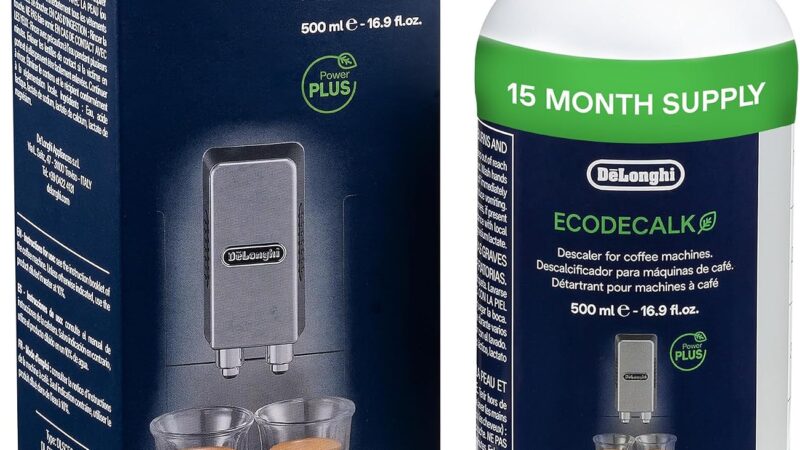
One useful reference point: De’Longhi labels a 500ml bottle of EcoDecalk as a 15-month supply, and it holds five doses. That works out at one descale roughly every three months, which is the manufacturer’s own assumption for typical use. In a hard-water area you’ll want to go more often than that.
Why not just use vinegar?
You’ll see vinegar recommended all over the internet because it’s cheap and it does dissolve scale. The problems are that it leaves a smell and taste that can take several rinse cycles to shift, and machine makers are wary of it. De’Longhi’s manuals tell you to use its own descaler and warn that using an unsuitable product can cause faults the warranty won’t cover. De’Longhi also advises against citric acid in its machines, since repeated use may affect the seals. If your machine is still under warranty, that alone is a good reason to use a proper descaler.
A closer look at De’Longhi EcoDecalk
EcoDecalk (model DLSC500) is a liquid descaler made in Italy. It’s based on lactic acid from plant sources rather than the citric acid in a lot of cheaper alternatives, and De’Longhi claims that makes it faster and more effective against scale while being gentler on the machine. It comes in a 500ml bottle that covers five descales, and each dose is 100ml of solution mixed into a litre of water.
Although it’s a De’Longhi product, it’s sold as a universal descaler, and the Amazon listing describes it as suitable for coffee makers generally. At the time of writing it sits at the top of Amazon UK’s coffee machine descaler bestseller list, with a huge number of customer ratings behind it, so it’s very widely used.
What’s good about it
- It’s the descaler De’Longhi itself tells owners to use, so there’s no warranty worry on a De’Longhi machine
- Lactic acid rather than vinegar, so no lingering smell or sour taste once you’ve rinsed through
- Simple dosing: one bottle, five measured uses, no guessing ratios
- A plant-based, biodegradable formula, if that matters to you
- Works in other brands of machine too, so it’s not a dead end if you switch
- Also sold as a two-bottle pack (DLSC502) if you descale often
What’s not so good
- It’s a branded product and priced like one. Reviews around the web regularly make the point that it’s pricey for what’s essentially five doses of acid. Generic descalers cost less per use, though you trade away the manufacturer’s blessing
- Five doses go quickly in a hard-water area. If you’re descaling every six weeks, one bottle won’t see you through the year
- It’s genuinely corrosive. The label carries a danger warning for severe skin burns and eye damage, and says it’s corrosive to the respiratory tract. It’s safe when used as directed, but this isn’t something to handle carelessly or leave where children can reach it
- It only deals with scale. Coffee oils and milk residue need a separate cleaner, and De’Longhi sells one (Eco MultiClean) for exactly that. Descaling alone won’t fix a greasy, bitter-tasting machine
- Check your own machine’s instructions first. Some brands, Nespresso included, sell their own descaler, and your manual may specify dosing that differs from the bottle
Who it’s for
If you own a De’Longhi machine of any kind, this is the obvious choice and there’s not much to debate. It also makes sense for anyone with a bean-to-cup or espresso machine they’ve spent real money on, where saving a little on descaler isn’t worth any risk to the internals.
If you’ve got a basic filter coffee maker, like the ones in our round-up of the best coffee makers for a small UK kitchen, a generic descaler will do the job fine and cost you less over a year. Just avoid vinegar if you care about the next few cups tasting right.
How to descale a coffee maker
The exact steps vary by machine, and your manual always wins, but the general process looks like this:
- Empty the water tank and remove any water filter cartridge, since descaler can damage it
- Pour 100ml of EcoDecalk into the tank and top up with a litre of water (or whatever your manual says for your tank size)
- Put a large container under the spout and steam wand, if you have one
- Start the descale programme if your machine has one. On a machine without one, run the solution through in stages, pausing for a few minutes between each so it has time to work
- Once the tank is empty, rinse it well, fill it with clean water and run at least one full tank through to flush out any remaining solution
- Refit the filter, reset the descale warning if there is one, and make a test coffee you’re happy to pour away
Most descale programmes take somewhere between 20 and 45 minutes including the rinse, so it’s a good job to start while you’re doing something else in the kitchen.
Staying safe while you do it
Wear gloves if you have sensitive skin, and be careful pouring the neat solution, since splashes near your eyes are the real risk here. Keep windows open if you’re in a small kitchen. Don’t mix different descalers or cleaners together, and never drink anything from the machine until you’ve done the full rinse. Store the bottle somewhere high or locked, away from children and pets.
FAQ
What happens if I never descale my coffee maker?
It’ll gradually heat less effectively, brew slower and make worse-tasting coffee. Eventually scale can block the pipes or burn out the heating element, and many manufacturers won’t cover scale damage under warranty.
Can I use EcoDecalk in a Nespresso or Sage machine?
It’s sold as a universal descaler for coffee machines. That said, some manufacturers sell their own and recommend it in their manuals, so check yours, particularly while the machine is under warranty.
Does a water filter mean I don’t need to descale?
It means you’ll need to descale less often, not never. Filters reduce hardness but don’t remove it completely, so keep an eye on the descale warning.
Can I use it in my kettle?
It’s sold for coffee machines, so that’s what we’d stick to. Kettle descalers are widely available and designed for the job.
How do I know if my machine needs descaling now?
Slow brewing, coffee that isn’t as hot as it used to be, louder pumping noises, or white flakes in the water tank are all signs. If you’re seeing any of those, don’t wait for the reminder.
The bottom line
Descale every two to three months as a starting point, more often if your kettle tells you you’re in a hard-water area, and follow your machine’s own reminder if it has one. De’Longhi EcoDecalk isn’t the cheapest way to do it, and five doses won’t last long with very hard water, but it’s effective, doesn’t leave your coffee tasting of vinegar, and keeps you on the right side of the warranty. For anyone with a machine they want to last, that’s worth paying a bit more for.