Most basters come out on Christmas Day and then vanish into a drawer until next December. If that’s how yours would live, skip it. A big spoon and a tilted roasting tin will get juices over a bird perfectly well. And there’s a decent argument that basting does less than people think. The liquid mostly runs off the skin, and every time you open the oven door you let the heat out.
Where a baster gets its place in the drawer is everything else you do with the tin. It’s the easiest way to suck up the fat that pools in the corner of a roasting tin, or to draw the juices off so you can start the gravy while the meat rests. A spoon chases those juices round the tin. A baster just takes them.
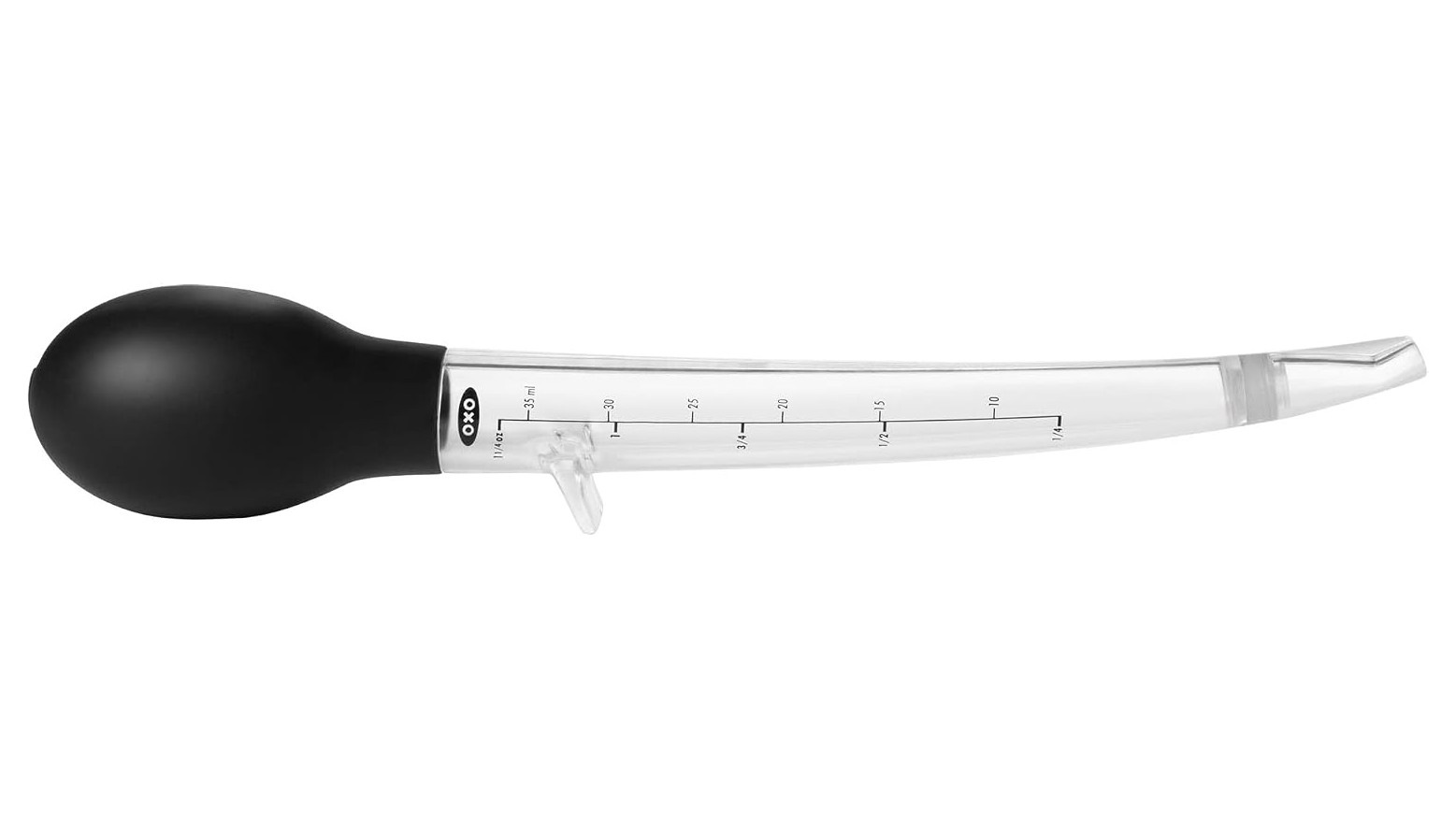
Why the angled OXO one
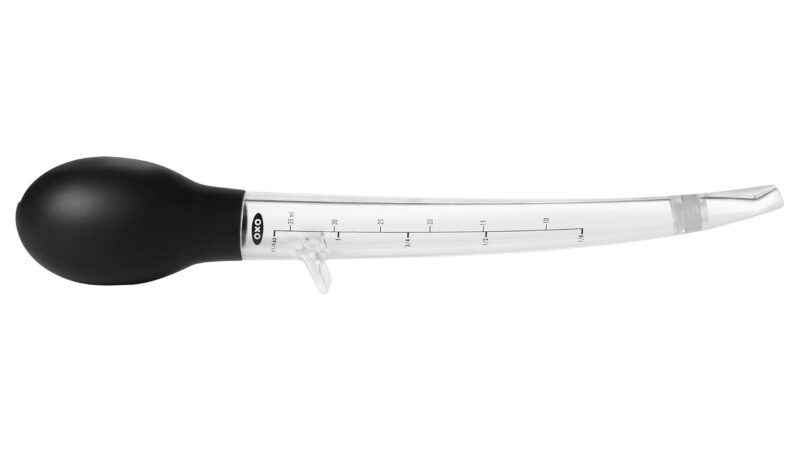
Most basters are a straight tube with a rubber bulb, and they work. I’d pay a little more for the OXO Good Grips Angled Baster for two reasons.
The first is the bend at the tip. With a straight tube in a deep tin, you end up holding it nearly upright with your wrist over the hot rim. The angled end reaches the corner of the tin at a more natural angle. The second is the little stand moulded onto the tube. Put it down on the worktop and it doesn’t roll away dribbling fat, which is exactly what a plain round tube does.
The rest of the listing is sensible. The bulb is silicone, the tube is marked in both ml and ounces, up to 35ml, which is a couple of tablespoons per squeeze, and the bulb and tip come off so you can clean inside with the brush that comes with it. It’s top-rack dishwasher safe and made from heat-safe materials. OXO also says it will repair or replace it if it gives you trouble.
Those markings are more useful than they sound. You can see how much fat you’ve taken off, and draw up a measured splash of stock without getting a jug out.
Other jobs it does
- Skimming fat off the top of a stew or stock. Lower the tip just under the surface and squeeze gently.
- Moving juices from the roasting tin to the gravy pan. This is easier than pouring from a heavy tin, and you can leave the fat behind. If gravy fat is your main headache, I’ve covered other ways to get the fat out of gravy too.
- Topping up the water around a ham or a steamed pudding without lifting the lid right off.
A couple of habits worth having
Take it apart to wash it. Fat left inside a baster goes rancid quickly, and you won’t see it through a cloudy tube until it smells. Run hot water through it straight after use, then pull the bulb off and use the brush.
Don’t leave it resting in the hot tin, either. “Heat safe” covers hot juices, not the bottom of a tin straight out of a 200°C oven.
And if you’re basting the turkey anyway, be quick about it. Get the tin out, baste, and get it back in, rather than doing it with the oven door open. Then let a meat thermometer tell you when it’s done, because that matters far more to a juicy bird than how often it was basted.