You tip the dough out of the banneton, it looks lovely, you draw your sharpest knife across the top, and it snags. The skin bunches up, the cut tears open in a jagged line, and the loaf sags a bit where you tugged it.
It’s not your technique, or not mostly. The reason a kitchen knife struggles is that sourdough is wet and sticky, especially after a long cold prove. Even a sharp knife has a thick edge compared with a razor, so it catches and drags the skin of the dough instead of slicing it. You get a ragged tear, and sometimes the loaf deflates a bit where you’ve pulled at it.
A razor blade goes through the surface with almost no pressure. That clean, shallow cut is what lets the loaf open up properly in the oven and gives you the raised “ear” along one side. So what you actually need is a razor blade. A lame is just a handle that holds one.
Why bother scoring at all?
Bread grows quickly in the first few minutes in a hot oven, and it has to burst somewhere. If you don’t give it a weak spot, it splits wherever the crust is thinnest, often the side or the bottom, and you end up with a lopsided loaf. A score tells it where to open.
For a soft sandwich loaf or a tin loaf, a serrated knife or even scissors is fine. It’s free-form sourdough and baguettes where a razor makes the biggest difference. (If your loaves are spreading flat before you even get to scoring, the problem is further back, in the shaping or the proving. There’s a post on what you need to shape sourdough that covers that.)
Why not just use a bare blade?
You can hold a bare razor blade between your fingers, and some bakers do. It’s awkward, and it’s very easy to cut yourself on the side you’re holding. That’s the main reason to get a lame.
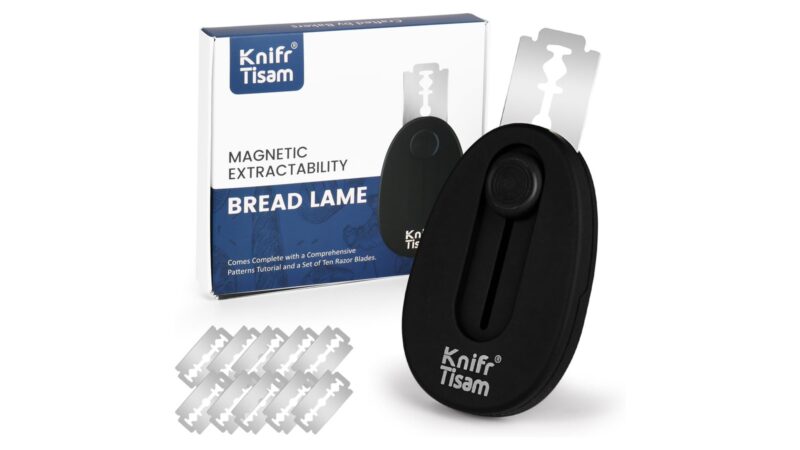
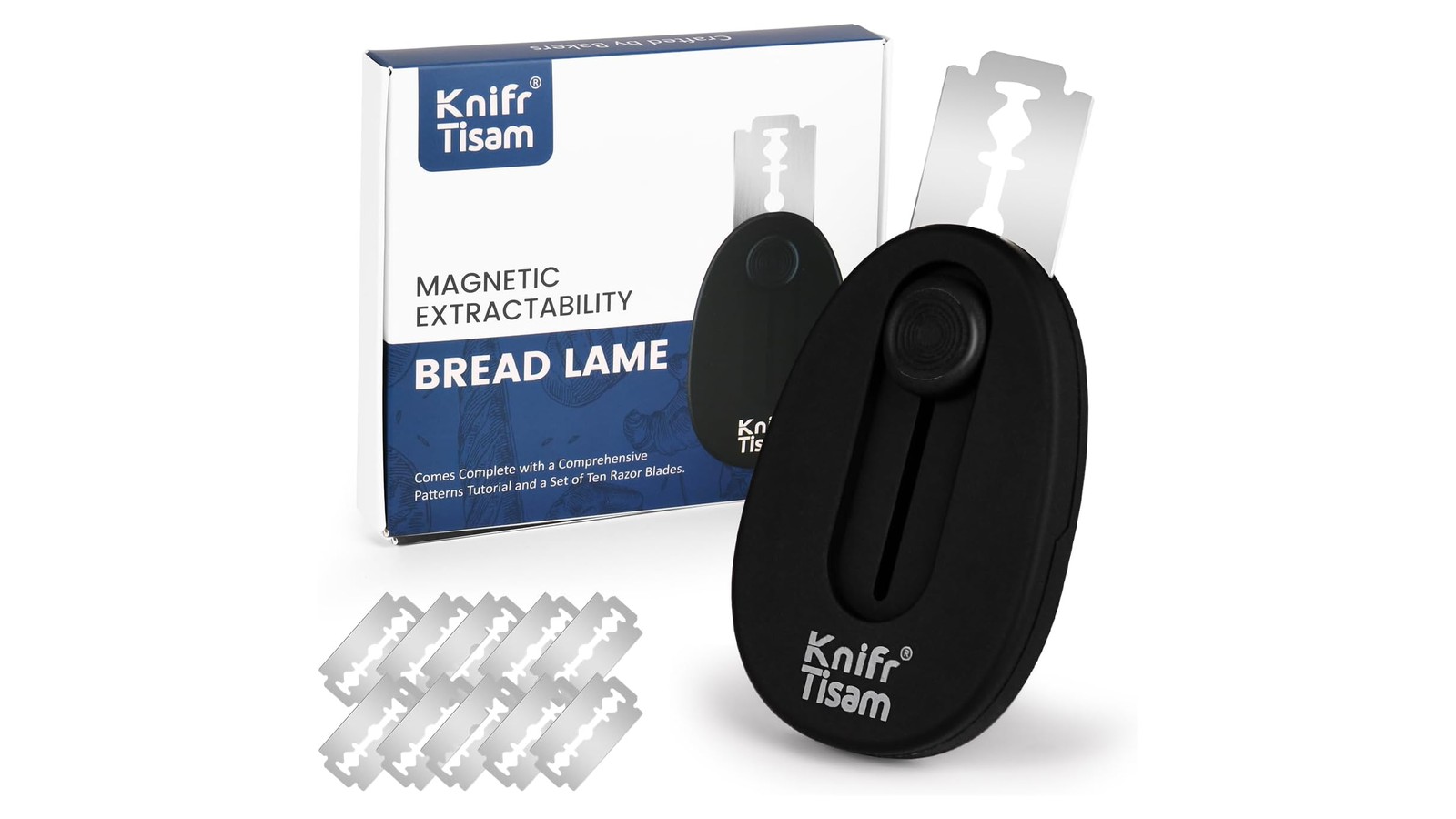
This KnifrTisam bread lame is an Amazon-only brand rather than a name you’d know, but the design is sensible and it’s well reviewed. It has a push-pull slider, so the blade slides out when you’re scoring and back into the plastic handle when you’re done. That’s handy if it lives in a drawer with other utensils. It’s magnetic, so you can stick it on the fridge or the side of the oven, and it comes with ten razor blades, which will last most home bakers a long time. There’s a little guide to scoring patterns in the box too, if you fancy trying wheat ears or leaves once you’ve got the basic cut down.
The handle is food-grade ABS plastic rather than wood. It’s not as pretty as the wooden-handled ones, but it’s easy to wipe clean and won’t mind a damp worktop.
How to get a good score
- Score straight after turning the dough out of the banneton, while it’s still cold from the fridge. Cold dough is firmer and cuts much more cleanly.
- Dust the top lightly with flour or rice flour first if it’s sticky.
- Hold the blade at a shallow angle, around 30 degrees to the surface, for an ear. Hold it upright for a cut that opens evenly on both sides.
- Go about half a centimetre to a centimetre deep, in one quick, confident stroke. Hesitating is what causes dragging, even with a razor.
- Swap the blade as soon as it starts catching. A dull razor drags just like a knife does.