Tinned beans are handy, but once you start getting through chickpeas and black beans every week, the dried bags start to look like a much better deal. They taste better too, and you control the salt. The usual objection is that you need a pressure cooker or an Instant Pot to make them worth the effort. You don’t. A heavy pan, your oven or a basic slow cooker will all get you there. It mostly comes down to planning ahead, not owning the right gadget.
Here’s how each method works, the one safety rule you can’t skip, and the slow cooker I’d point most people towards if they want to set it and walk away.
At a glance
- Easiest hands-off method: a slow cooker on low, after an overnight soak
- Fastest without special kit: soaked beans simmered on the hob in a big, heavy pan
- Most forgiving: a lidded casserole dish in a low oven, which is hard to boil dry
- Non-negotiable: red kidney beans need a hard 10-minute boil before any slow cooking
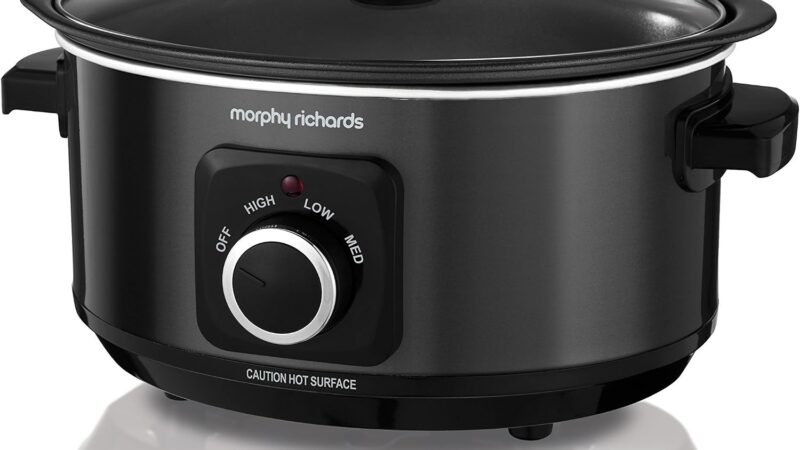
- Our slow cooker pick: the Morphy Richards 3.5L Sear & Stew, because its pot can go straight on the hob for that boil
First, soak them (mostly)
Soaking isn’t strictly required for every bean, but it cuts the cooking time a lot and helps them cook evenly. Cover the beans with at least three times their volume of cold water, because they swell a surprising amount, and leave them overnight. Drain, rinse, and cook in fresh water.
Forgot to soak them? Do a quick soak. Bring the beans to the boil, let them bubble for a couple of minutes, then take them off the heat and leave them covered for an hour. It isn’t quite as good as an overnight soak, but it’s close enough on a weeknight.
Lentils and split peas are the exception. They’re small enough to cook from dry in 15 to 40 minutes, depending on the type, so there’s no need to plan for them.
Method 1: on the hob
This is the classic way, and it’s quicker than most people expect. Put the soaked beans in your biggest pan with plenty of fresh water, bring it to a rolling boil, skim off the foam, then turn it down to a gentle simmer with the lid partly on. Chickpeas usually need somewhere between one and two hours. Black beans and haricot beans tend to be quicker. Older beans take longer, and there’s no real way to tell how old a bag is, so start tasting early.
The test is simple: squash one against the roof of your mouth. It should be creamy all the way through with no chalky centre. Salt the water towards the end, or from the start if you like. The old idea that salt stops beans softening has mostly been debunked, and seasoned water gives you better-tasting beans.
Method 2: in the oven
If you’re worried about a pan boiling dry while you’re in the other room, the oven is the calmer option. Bring the beans and water to the boil on the hob in a lidded, ovenproof casserole dish, give kidney beans their full 10 minutes, then move the dish into a low oven with the lid on. A cast-iron casserole is ideal, but any heavy dish with a lid will do. Check them after an hour and top up the water if needed. The steady, even heat is gentle on the skins, so you get fewer split beans than you would from a hard simmer.
Method 3: in a slow cooker
This is the one I’d actually recommend for batch cooking. Soak the beans overnight, drain them, add fresh water to cover by a few centimetres, and leave them on low for most of the day. You come home to a pot of cooked beans without having to keep an eye on anything. It’s also the method most likely to go wrong for one particular bean, which brings us to the safety bit.
The kidney bean rule
Raw and undercooked red kidney beans contain a natural toxin called phytohaemagglutinin, and it can make you properly ill. The Food Standards Agency advises soaking dried kidney beans for at least 12 hours, then boiling them vigorously for at least 10 minutes before simmering until cooked. A slow cooker on its own may not get hot enough to destroy the toxin, and slightly undercooked beans can actually be worse than raw ones. So kidney beans always get that hard boil first, whatever method you use afterwards. Cannellini beans contain the same toxin in smaller amounts, so give them the same treatment if you’re unsure.
This is the main reason we picked the slow cooker below. You can do that boil in its own pot, on the hob, before it goes into the base.
The slow cooker we’d pick: Morphy Richards 3.5L Sear & Stew
Morphy Richards’ Sear & Stew is one of the best-known slow cookers in the UK. It’s one of the most reviewed slow cookers on Amazon UK, and owners rate it very highly. The reason it suits bean cooking is the pot. Most slow cookers have a heavy ceramic crock that can’t go anywhere near a hob. This one has a lightweight non-stick aluminium pot that Morphy Richards describes as hob proof. You can boil your kidney beans hard on the cooker for 10 minutes, then lift the pot into the base and switch to low for the rest of the day. That’s one pot to wash instead of two.
It holds 3.5 litres, which is plenty for a 500g bag of dried beans with water to spare. It has three heat settings (low, medium and high) on a plain dial, a glass lid so you can check progress without letting the heat out, and the pot is dishwasher safe. The whole thing weighs about 2kg according to the listing.
Living with the aluminium pot
The pot is the best and the worst thing about it. On the plus side:
- The hob-proof pot does the kidney bean boil, onion softening or browning, then goes straight into the slow cooker
- It’s light, so lifting a full pot out to drain is much easier than with a ceramic crock
- The non-stick coating makes cleaning easy, and the pot goes in the dishwasher
- 3.5 litres is a good size for one to four people, or a decent batch of beans to freeze in portions
- Owners consistently say it’s simple to use and good value
And the trade-offs:
- The coating is the weak spot. A handful of 3.5L owners report the non-stick lining bubbling or flaking after a few months. Wooden or silicone utensils and gentle washing will help, but it won’t last as long as a glazed ceramic crock.
- It isn’t suitable for induction. Morphy Richards says so on the listing, so the “sear on the hob” feature only works on gas, electric and ceramic hobs.
- Go easy on electric hobs. We found a complaint about the pot leaving marks on an electric hob the first time it was used. Keep the heat moderate, use a ring that matches the base, and don’t heat it empty.
- No timer, no auto keep-warm. It’s a manual dial, so it keeps going on whatever setting you leave it on until you turn it off. Beans are forgiving, but plan your day around it.
So it’s a great fit if you’re cooking beans, chickpeas, chilli or stews for a small household and you’d rather not stand over a pan for two hours. On an induction hob, you’d have to do the kidney bean boil in a separate pan, which loses most of the appeal. If you want a programmable timer that switches to warm on its own, you’ll need a digital model instead.
How to cook a batch of chickpeas in it
- Soak 500g of dried chickpeas overnight in plenty of cold water
- Drain, rinse, and tip them into the pot with fresh water covering them by about 5cm
- Bring to the boil on the hob, skim off any foam, then put the pot in the base
- Cook on low for six to eight hours, checking from about the six-hour mark
- Drain (keep some of the liquid for hummus or to thicken a stew), cool quickly, then fridge or freeze
For kidney beans, swap the quick boil for a full 10 minutes at a rolling boil before the pot goes into the base.
Cleaning and safety
Let the pot cool before washing it, because cold water on a hot aluminium pot is asking for trouble. The pot is dishwasher safe, but a soft sponge by hand will look after the coating for longer. Skip metal spoons and scourers. The outside of the base gets hot, as the “caution hot surface” label on the front reminds you, so give it some space on the worktop and keep the cable tucked away from the edge.
Cooked beans should be cooled and refrigerated within a couple of hours. If you’re batch cooking for the week, splitting them into smaller containers helps them cool faster. We’ve covered the best containers for vegan batch-cook meal prep if you need some.
FAQ
Can I cook dried beans in a slow cooker without soaking them?
You can for some beans, but it takes much longer and they cook less evenly. Never do it with red kidney beans. They need a soak and a hard 10-minute boil first.
How much does a bag of dried beans make?
Dried beans roughly double to two and a half times in weight once cooked, so a 500g bag gives you somewhere around 1.1kg to 1.25kg of cooked beans. That’s about the same as three to four standard tins, drained.
Can I freeze cooked beans?
Yes, and they freeze really well. Freeze them in portions with a splash of their cooking liquid to stop them drying out, and they’ll keep for a few months.
Why are my beans still hard after hours of cooking?
It’s usually old beans, very hard water, or adding something acidic like tomatoes or vinegar too early, which slows softening. Cook the beans first and add acidic ingredients once they’re tender.
Is a pressure cooker worth it instead?
If you cook beans several times a week and hate planning ahead, it can be. We looked at tools that make cooking beans, lentils and tofu easier, including an electric pressure cooker. For most people, though, an overnight soak and a slow cooker do the job just as well.
The verdict
You don’t need a pressure cooker to cook dried beans well. You just need to soak them, give kidney beans their hard boil, and pick the method that fits your day. The hob is quickest and the oven is the most forgiving. A slow cooker is the most hands-off, and the Morphy Richards Sear & Stew is a good one for this job, because the same pot handles the boil and the long, slow cook. Just treat the non-stick coating gently and don’t buy it expecting it to work on induction.
Check the Morphy Richards 3.5L Sear & Stew Slow Cooker on Amazon UK