You can use your fingers. Rubbing in is how most of us learned to make pastry and scones at school, and plenty of very good bakers never use anything else. Whether you should comes down to one thing: how warm your hands are.
Flaky pastry and tall scones rely on little lumps of cold butter staying cold until they reach the oven. In the heat, the water in the butter turns to steam and pushes the layers apart. Warm fingers melt those lumps into the flour, and you get something tough or greasy that’s closer to shortbread. Cold-handed people never notice. Everyone else has probably had a disappointing pie crust and blamed the recipe.
A food processor fixes the temperature problem, but it’s easy to overdo, and that’s a bowl, a blade and a lid to wash for one batch of scones.
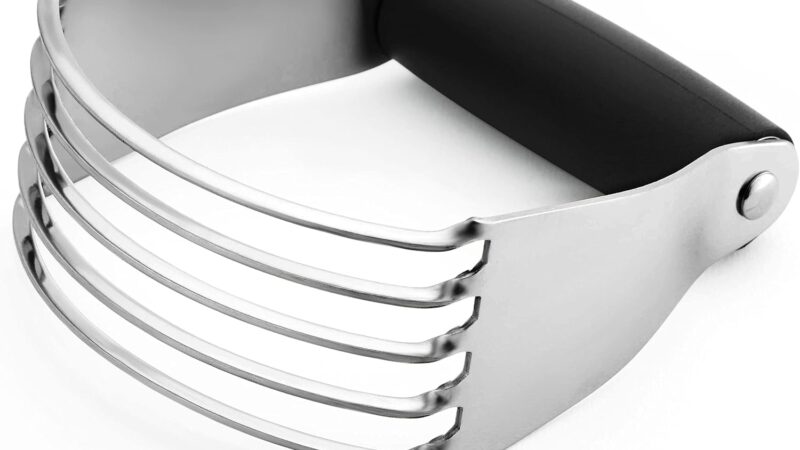
A pastry blender sits in between. It’s a D-shaped handle with curved metal blades underneath. Press it into the bowl of flour and cubed butter, rock it, press again, and the blades chop the butter smaller and smaller without your hands touching it. Stop when it looks like breadcrumbs with a few pea-sized lumps still showing. You want those lumps.
The one to get
I’d go for the Spring Chef medium dough blender. It has solid metal blades rather than thin wires, and that’s the main thing to look for. Wire blenders clog and splay the first time they meet fridge-cold butter. Spring Chef say these blades are twice as thick as some others.
The handle is thick rubber, which is easier on your wrists if you’ve got arthritis or you’re making a big batch, and the whole thing goes in the dishwasher.
It earns its drawer space outside of pastry, too. I’d use it for mashing avocado, breaking up boiled eggs for egg mayo, and rubbing together a crumble topping when the oven’s already on and the kitchen’s warm.
If you make pastry once a year, keep using your fingers and run them under the cold tap first. If you bake every week and your results are hit and miss, this is a small, cheap change that’s worth trying.