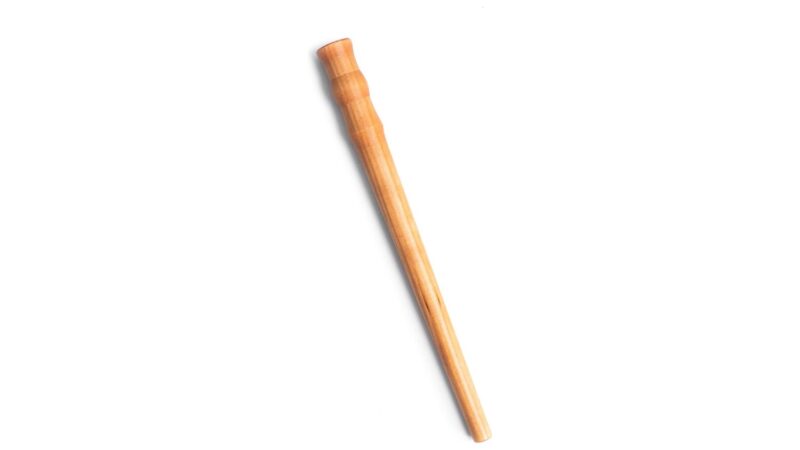
Use a spurtle. It’s a wooden stick, about the length of a wooden spoon but with no bowl on the end, and it’s the traditional Scottish tool for porridge. It does a better job than a spoon for a simple reason.
Lumps form in the first couple of minutes. The oats hit the hot liquid, the starch on the outside swells, and any oats touching each other stick together before they’ve separated. A spoon’s wide bowl pushes the oats around as one mass. A spurtle is thin and round, so it cuts through them and pulls the clumps apart as you stir. With no bowl, there’s also nowhere for porridge to set like cement while it sits on the side.
The one I’d point people to is this Lancaster Wooden Spoons Scottish spurtle. It’s 11 inches long and made in Pennsylvania from a single piece of American black cherry, with a thistle carved into the top. It’s sanded smooth and the maker backs it with a lifetime warranty. Hand wash it, dry it, and oil it now and then like a chopping board. Keep it out of the dishwasher. Risotto and polenta get the same benefit, since they’re both stir-without-mashing jobs.
The rest of the trick
The spurtle helps, but technique does just as much:
- Start the oats in cold or lukewarm milk or water and heat them up together. Tipping oats into boiling liquid is how you get lumps.
- Stir constantly at the start, then you can ease off once it begins to thicken.
- Salt at the end. Scottish tradition says salt added early toughens the oats. Either way, it’s easier to judge once it’s thick.
- Take it off the heat while it still looks slightly too loose. It thickens in the bowl in about a minute.
Stir in figures of eight rather than circles and you’ll reach the corners of the pan, where the stuck bits usually start.