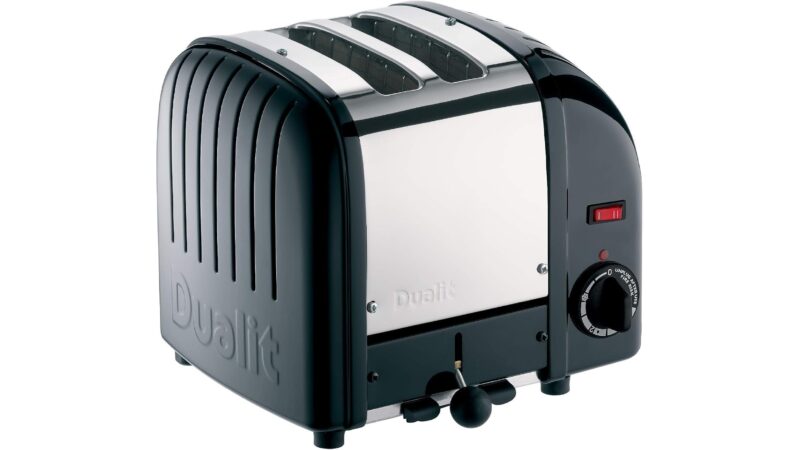
Winter is crumpet season. It’s also teacake, hot buttered toast at 4pm and “just one more slice” season, which is when a flimsy toaster starts to show itself up. If you’ve been eyeing the Dualit Classic 2 Slice Vario Toaster and wondering whether it’s a genuinely better machine or just a very handsome lump of steel, here’s my honest take.
The short answer
It’s worth it if you want a toaster you can repair instead of replace. If you just want toast and don’t care how long the thing lasts, a mid-range plastic toaster will do the job for a lot less.
What makes it different from a normal toaster?
Most toasters are built to be thrown away. When an element goes, that’s it. The Dualit Classic goes the other way. Each one is hand assembled at Dualit’s factory in the UK (the assembler’s name is printed on the base plate, which is a lovely touch), and the parts can be bought separately and swapped if something fails. Dualit says it has been building this toaster here since 1952.
The elements are Dualit’s own “ProHeat” type, which have a protective armoured layer over them. The point is that they’re much harder to break than the bare wire elements in a typical toaster, and that’s the part that usually dies first.
The bits you’ll notice day to day
- A wind-up timer instead of a browning dial. It’s a mechanical timer, so you set the time rather than picking a number from 1 to 6. It takes a couple of goes to learn, then it’s very consistent.
- A slot selector. You can heat just one slot when it’s only you, which saves a bit of energy over a whole winter of single slices.
- An ejector lever that lets you lift the bread mid-toast to check it. This is the feature crumpet people will love, because crumpets go from pale to scorched in about thirty seconds.
- A defrost setting for bread straight from the freezer.
- Non-slip feet, so it doesn’t skate around the worktop when you push the lever down.
It’s roughly 26cm wide, 21cm deep and 22cm tall, so it’s compact for a two-slice, but it is heavy and it’s not going back in a cupboard every morning. It lives on the counter.
What I’d want you to know before buying
The outside gets hot. It’s a metal box with heating elements inside, so keep little fingers away from the sides. There are also no fancy extras: no bagel button, no digital countdown, no “lift and look” automation. The whole appeal is that there’s very little to go wrong.
It’s also one of the pricier two-slice toasters you can buy. The way I’d think about it is cost per year. If a cheap toaster lasts you three or four winters and this lasts fifteen or twenty with the odd replacement part, the maths starts to look a lot kinder.
Who should skip it?
If you mostly toast thick sliced sourdough or big bloomer slices, check the slot size against your usual loaf first. And if you’re in rented accommodation and likely to move a few times, the “buy it for life” pitch matters less than having something light you can chuck in a box.
For everyone else, especially households that get through a lot of toast and crumpets once the weather turns, it’s one of the few kitchen appliances that genuinely earns its reputation.