Living alone or just the only coffee drinker in the house changes what actually makes sense on your counter. A 12-cup filter machine sitting there for one mug a day is overkill, and pod machines rack up ongoing costs for capsules you have to keep buying. After comparing three genuinely different single-serve approaches on real specs and real owner reviews, here’s what actually works for brewing coffee for one in a UK kitchen.
At a glance
- Best all-rounder: Salter One Cup Coffee Maker – electric, brews in 3-4 minutes, comes with a travel mug for grab-and-go mornings
- Best if you already love strong coffee: Bialetti Moka Express 1 Cup – the classic Italian stovetop pot, no electricity or pods needed
- Best for people who take their coffee seriously: AeroPress Original – manual press that most reviewers rate above their old French press or pod machine
- Watch out for: none of these are espresso machines in the strict sense, even where the marketing gets close to implying it – more on that below
Salter One Cup Coffee Maker
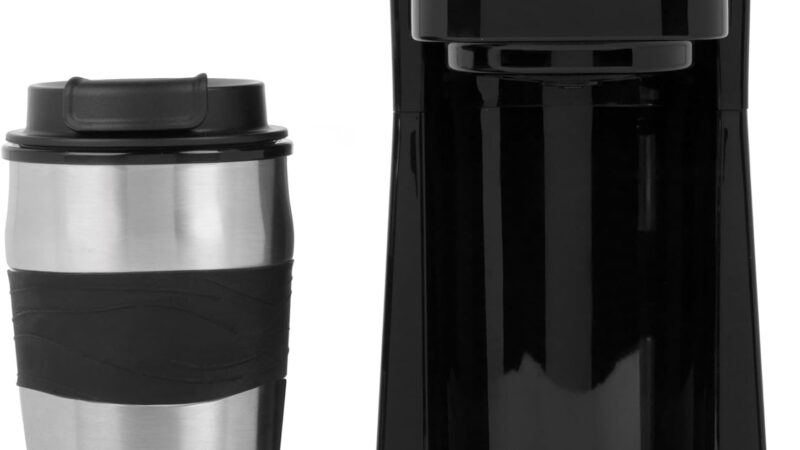
This is the simplest option here: fill the 0.45-litre tank, add ground coffee or a coffee pad to the washable filter, and press one button. It brews a full mug in 3-4 minutes and comes with a 420ml stainless steel travel mug, which is the main reason it turns up in so many “for the commute” reviews – you can brew straight into the mug and walk out the door with it. At 13 x 17.5 x 24.5cm it’s genuinely small enough to live in a cupboard between uses rather than taking up permanent counter space.
The reusable filter means no ongoing paper filter costs, and owners who’ve had it for years report it still working fine with an occasional descale. The catch, and it comes up repeatedly in reviews, is that the stock plastic filter brews on the weak side by default. Several long-term owners solve this by swapping in a standard paper filter instead of the supplied reusable one, which they say produces a noticeably stronger, cleaner-tasting cup. It also has no drip tray, so if you lift it before it’s finished draining fully, it will drip on your counter. A minority of owners also report the brew becoming inconsistent after a few months of regular use, needing the button pressed more than once to get a full mug.
Bialetti Moka Express 1 Cup
The Moka Express has been made in Italy since 1933, and the 1-cup size is the smallest version of the same aluminium stovetop pot that’s sat in Italian kitchens for generations. There’s no electricity involved: you fill the base with water, pack the basket with ground coffee, screw the top on, and put it on the hob until it starts bubbling. What comes out isn’t quite espresso, but it’s a strong, concentrated, full-flavoured coffee that a lot of reviewers describe as better than anything a pod machine produces.
Reviewers who are honest about the 1-cup size say it’s genuinely small – you get roughly a third of a standard mug, which suits someone who wants a short, strong coffee rather than a large one. If you’d prefer more volume, Bialetti sells the same pot in 2-cup and larger sizes. Two other real limitations: it’s aluminium, so it can’t be used on an induction hob without a separate induction plate, and the coffee basket can be fiddly to pull out and empty while it’s still hot. It also comes with the standard stovetop safety warnings, since it’s sitting directly on a flame or hot ring rather than being a sealed electric appliance.
AeroPress Original
The AeroPress is a manual press that works a bit like a cross between a French press and an espresso maker: you steep ground coffee in hot water inside a plastic cylinder, then push it through a paper (or reusable metal) filter with a plunger. The result is a smooth, low-bitterness cup that a large number of reviewers specifically say tastes better than their previous French press, with none of the gritty sediment at the bottom of the cup that a mesh filter lets through.
It’s genuinely popular with people who care about coffee – there’s an annual World AeroPress Championship built entirely around this device – but it’s worth being clear-eyed about what it isn’t. Despite some marketing language mentioning “espresso style,” it only generates around 2 bars of pressure, nowhere near the 9 bars a real espresso machine uses, so what you get is a strong, concentrated coffee rather than true espresso. It’s also entirely plastic, which some reviewers feel is a lot to pay for what is, physically, a fairly simple object, and you do need a stable surface and a reasonably firm push to get it to work properly. You’ll also need to keep buying paper filters, though a pack lasts a long time for one person’s daily use.
How to use any of these well
For the Salter, swap the supplied reusable filter for a standard paper one if you find the default brew too weak, and don’t walk away until it’s finished dripping. For the Bialetti, keep the flame low enough that it doesn’t lick up the sides of the pot, and take it off the heat as soon as you hear the bubbling sound rather than letting it keep cooking, or the coffee turns bitter. For the AeroPress, don’t skip the stir after adding water, and press down steadily rather than forcing it – if it’s hard to push, the grind is probably too fine.
Cleaning and safety
The Salter’s filter and travel mug are dishwasher-safe, though hand-washing the mug keeps the insulation lid seal in better condition long-term. The Bialetti should be rinsed with water only, no washing-up liquid, since traditional advice is that soap strips the seasoning that builds up inside and affects the taste over time; let it cool fully before disassembling, since the metal gets very hot on the hob. The AeroPress rinses clean in seconds once you push the used grounds out, and the seal ring should be checked occasionally for wear since that’s the part most likely to need replacing after heavy use.
FAQ
Do any of these make real espresso?
No. The Bialetti and AeroPress both produce a strong, concentrated coffee that’s closer to espresso than filter coffee, but neither reaches the pressure a real espresso machine uses, so the crema and texture will be different.
Which one needs the least ongoing cost?
The Bialetti and the Salter (used with its reusable filter) need nothing beyond ground coffee. The AeroPress uses paper filters that need replacing, though a single pack covers months of daily use for one person.
Which is best for a small flat with no gas hob?
The Salter, since it’s electric and doesn’t depend on hob type at all. The Bialetti needs a gas or electric ring and specifically won’t work on induction without an adapter plate.
Is the AeroPress worth it over a cheaper option?
If you already know you like strong, clean-tasting coffee and don’t mind a bit of manual effort each morning, most owners say yes. If you just want to press a button and walk away, the Salter is the easier fit.
The verdict
For most people making coffee for one, the Salter One Cup is the easiest recommendation: it’s electric, comes with a travel mug, and needs almost no technique to use well. Go for the Bialetti Moka Express if you want a strong, traditional stovetop coffee and don’t mind the tiny single-cup size, or the AeroPress if you’re willing to spend two minutes on technique for a genuinely better-tasting cup.
Salter One Cup Coffee Maker on Amazon UK