A drip machine is convenient, but it’s also the reason a lot of home coffee tastes thinner and flatter than what you’d get at a café. Paper filters strip out the oils that carry most of a coffee’s flavor. A French press skips the paper entirely, which is the whole reason people who care about coffee keep coming back to a design that hasn’t really changed in decades.
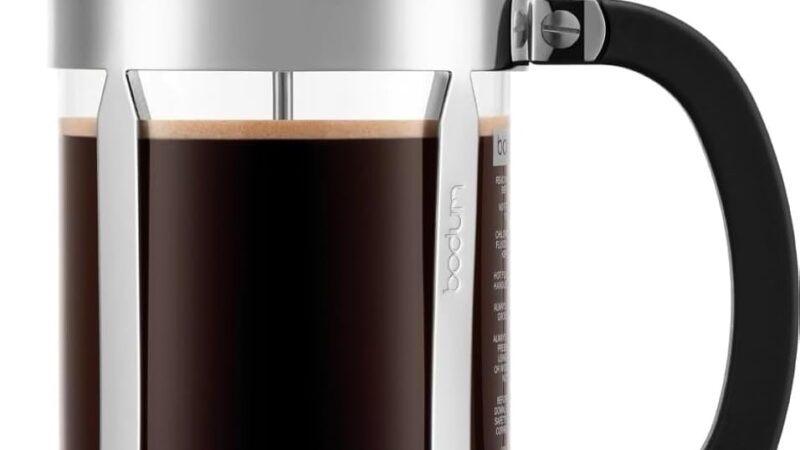
The Bodum Chambord is the one you’ve probably seen in a hundred kitchen photos without knowing its name. It’s the classic silhouette: a glass carafe wrapped in a polished stainless steel frame, with the plunger and filter mechanism dropping through a hinged lid. It holds 34 ounces, about a liter, which works out to roughly four standard cups.
Why the brewing method matters
Steeping coarse grounds directly in hot water, then pressing them to the bottom with a metal mesh filter, lets the coffee’s natural oils stay in the cup instead of getting caught in paper. That’s the difference people notice immediately: a French press produces a heavier, more full-bodied coffee than drip. It’s also nearly foolproof. There’s no machine to calibrate, no pods to buy, and no power outlet required. You control everything, which is either the appeal or the drawback depending on how much you like fiddling with your morning routine.
The carafe itself is high-heat borosilicate glass, the same type used in lab equipment and oven-safe cookware, so it handles the temperature swing from boiling water without cracking under normal use. The frame is made in Portugal, where Bodum has produced the Chambord line for years, and the polished steel gives it a look that doesn’t scream “budget kitchen gadget” sitting out on a counter.
What to keep in mind
Wash it thoroughly before the first use and it’s not rated for stovetop, so it’s strictly for hot water you’ve boiled separately, whether that’s a kettle or a stovetop pot poured in after the fact. The lid twists to close off the spout when you’re not pouring, which keeps the coffee hotter for longer if you’re not drinking the whole pot in one sitting.
It’s genuinely one of those tools where the design earns its reputation. If you’ve been making do with pod machines or basic drip and want to actually taste what a coffee bean is doing, this is the low-effort way to find out.