Stir-up Sunday, the last Sunday before Advent, falls on 22 November this year, so if you’re making your own Christmas pudding, now’s the time to sort out what you’re going to steam it in. Technically any heatproof bowl will do, but a proper pudding basin makes the whole thing a lot less stressful.
Why a proper basin matters
A Christmas pudding steams for hours, then usually again on the day. Over that time, three things go wrong in the wrong bowl. The covering slips off and water gets in, which leaves you with a soggy top. The bowl rattles about or tips in the pan. And at the end, the pudding won’t come out in one piece.
A traditional basin deals with all three:
- A thick rolled rim. You tie string under it, so the paper and foil lid can’t creep up.
- Sloping sides. These are what give a pudding its dome and let it slide out when you turn it over.
- A steady base. It sits flat in the pan and doesn’t wobble when the water bubbles.
Our pick: Mason Cash Original Pudding Basin
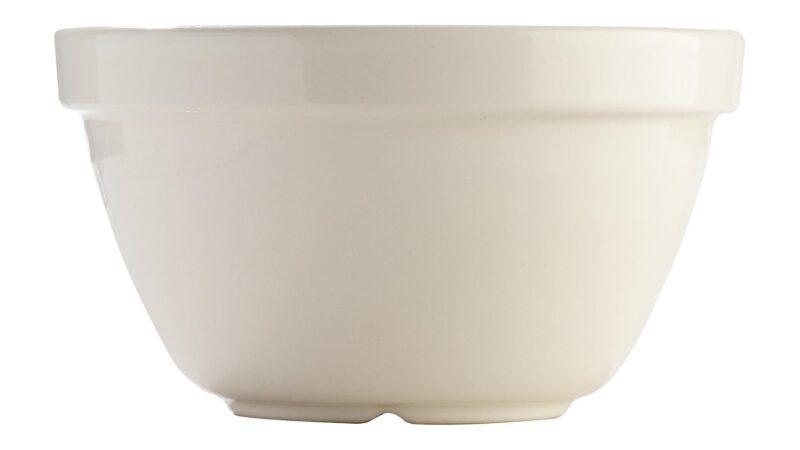
Mason Cash basins are the ones your gran probably had, and the design has barely changed in about two hundred years. The Mason Cash Original 20cm pudding basin is cream stoneware with exactly that rolled rim for tying. Mason Cash also says the base is vented, so bubbles can escape from underneath instead of lifting and tipping the basin while it steams.
It’s 19.5cm across, 11cm tall and holds 1.75 litres. That’s bigger than the 1.2 litre (2 pint) basin a lot of recipes ask for, so it suits a family-sized pudding, or a recipe scaled up a bit. If your recipe says 2 pints, Mason Cash sells smaller sizes in the same range. It’s dishwasher, microwave and freezer safe, and the rest of the year it makes a good mixing or serving bowl, so it isn’t one of those things that lives in the loft for eleven months.
How to steam a pudding without it going soggy
- Grease the basin well with butter and put a small disc of baking paper in the bottom.
- Spoon in the mixture, leaving a couple of centimetres of space at the top for it to rise.
- Lay a sheet of baking paper over a sheet of foil and fold a pleat in the middle so the pudding has room to rise. Put it over the basin, foil side up.
- Tie it tightly with string just under the rim. Make a string handle across the top too, so you can lift the basin out.
- Stand it on an upturned saucer or a trivet in a big pan. Pour in boiling water to about halfway up the basin, put the lid on and keep it at a gentle simmer. Check the water level every hour or so and top it up with boiling water from the kettle.
Follow your recipe for timings. Most puddings need several hours on the first steam and a couple more on Christmas Day.
One last thing: a stoneware basin is heavy when it’s full and hot. Use the string handle and a pair of oven gloves, and let it sit for a few minutes before you turn it out.